Insulin resistance, immune dysregulation, thyroid dysfunction, gut permeability, HPA axis disruption — all of these generate and are sustained by one unifying mechanism. This is the episode that pulls the threads together. And it opens with a question directly to you.
A DIRECT QUESTION — BEFORE WE BEGIN
Do you wake up stiff — not dramatically, just a heaviness in your joints and muscles that takes a while to clear?
Do you have a persistent low-level fatigue that doesn't fully resolve no matter how much you rest?
Do you carry weight around your abdomen that doesn't respond the way you'd expect to dietary effort?
Do you have a brain fog that comes and goes without obvious cause?
Do you have a skin condition — eczema, psoriasis, rosacea, acne — that flares unpredictably?
Do you have a mood that sits lower than it should, or an anxiety that feels disproportionate to your circumstances?
If you said yes to more than two of those — your body is not failing at random. It is not ageing badly. It is not a collection of separate, unconnected symptoms. Your body is inflamed. Chronically. And it is trying to tell you something.
Three weeks into April, and if you've been following the series, you now have the metabolic picture — insulin resistance, its mechanisms, its downstream cascade. You have the autoimmune and thyroid connection — how the metabolic environment drives immune dysregulation and thyroid dysfunction. Today I want to give you the thread that runs through all of it.
Chronic inflammation. It is the mechanism behind insulin resistance — because visceral adiposity generates a continuously inflammatory cytokine environment. It is the mechanism behind immune dysregulation — because the Th17/Treg imbalance is driven by inflammatory signalling. It is the mechanism behind thyroid conversion impairment — because inflammatory cytokines directly suppress deiodinase activity. It connects gut permeability to systemic immune activation. It connects the HPA axis to metabolic dysfunction.
It is not a symptom or a diagnosis. It is a physiological state that underlies almost every chronic condition I see in clinical practice. And in the majority of cases, it is addressable at the source.
Acute vs Chronic: Two Completely Different Things
The word "inflammation" is used so frequently and so broadly that it has lost some of its clinical specificity. The distinction between acute and chronic inflammation is not just conceptual — it is the clinical argument for why suppression without resolution is insufficient.
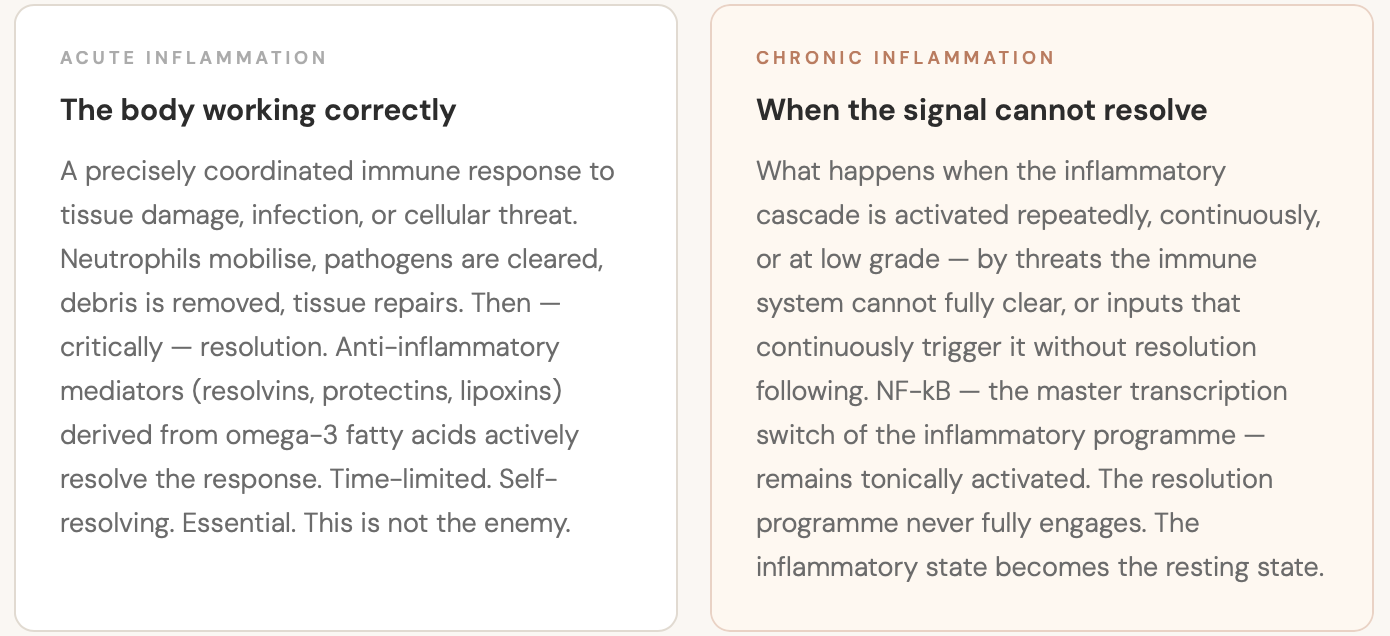
“Chronic inflammation produces no dramatic symptoms. No fever. No obvious swelling. Just a persistent, systemic, cellular-level state of activation that you feel as fatigue, brain fog, joint stiffness, and mood disruption — and that standard testing almost never captures.”
The Five Primary Sources
Chronic inflammation is a sustained physiological signal — which means the clinical question is: what is generating it? Because genuine treatment begins with identifying and removing the sources. These are the five I work with in clinical practice.
1 The metabolic-adipose driver
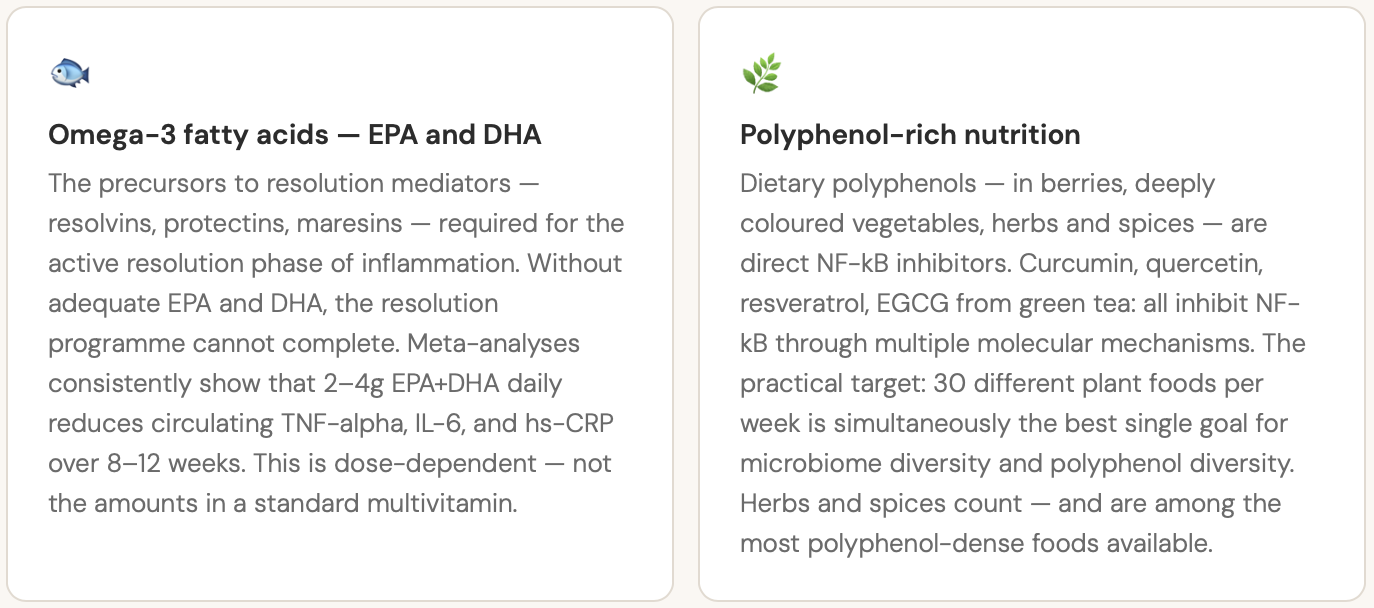
Visceral adipose tissue — fat around the abdominal organs that accumulates with insulin resistance — is an active inflammatory endocrine organ, producing TNF-alpha, IL-6 and IL-1β continuously. This is the primary driver of chronic NF-kB activation in the majority of my patients. Reducing visceral fat through the dietary and movement interventions covered in Episode 1 directly reduces this inflammatory source.
2 Gut-derived inflammation (metabolic endotoxaemia)
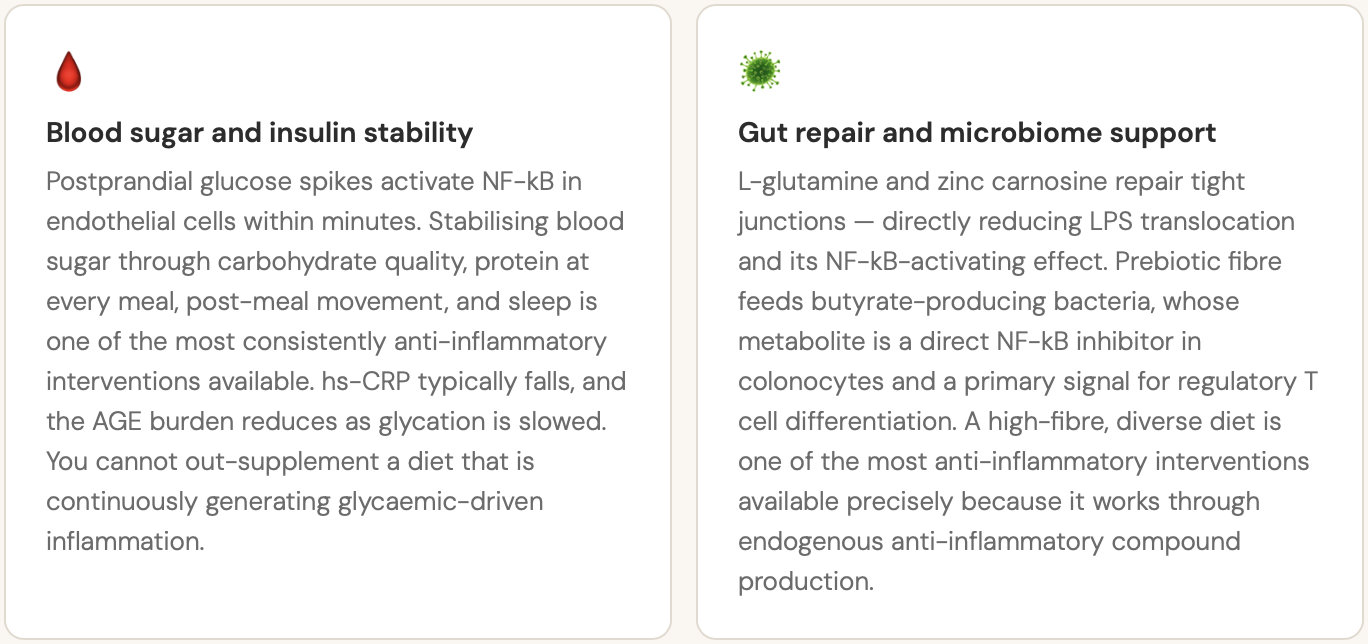
When the gut lining is permeable, bacterial lipopolysaccharides (LPS) — components of gram-negative bacterial cell walls — translocate into the bloodstream. LPS is one of the most potent activators of NF-kB known. Even at low concentrations, chronic LPS exposure in the bloodstream drives a state of persistent systemic inflammatory activation. This is why gut repair is a direct anti-inflammatory intervention, not merely a digestive one.
3 Chronic glycaemic dysregulation
Postprandial glucose spikes are independently pro-inflammatory through multiple mechanisms: activation of the AGE-RAGE axis (advanced glycation end products binding to their receptors and driving NF-kB), direct endothelial NF-kB activation, and oxidative stress generation. Every blood sugar spike is an inflammatory event. Blood sugar stability is an anti-inflammatory intervention — not a weight loss strategy.
4 Chronic stress and HPA dysregulation
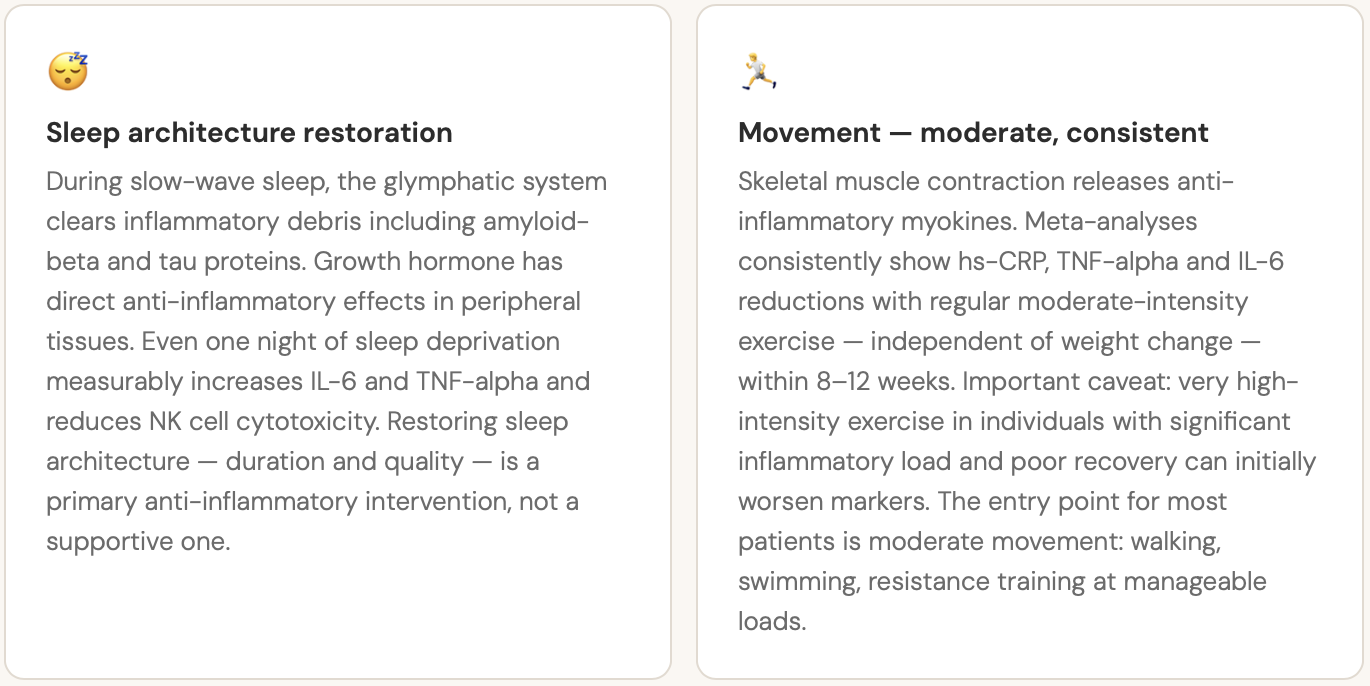
As established in March: chronic HPA activation leads to glucocorticoid resistance in immune cells — the braking mechanism fails, and pro-inflammatory cytokines increase unchecked. The HPA axis and the inflammatory axis are the same axis, approached from different directions. Every stress physiology intervention is simultaneously an anti-inflammatory intervention.
5 Dietary pro-inflammatory load
Ultra-processed foods, refined seed oils, excess omega-6 relative to omega-3, advanced glycation end products from high-heat cooking of processed foods, and artificial additives all contribute to tonic NF-kB activation. The omega-6:omega-3 ratio in cell membranes directly determines the balance between pro-inflammatory and anti-inflammatory eicosanoid production — and in the modern Western diet, this ratio is often 20:1 or higher, compared to an evolutionary ratio closer to 4:1.
What Actually Reduces It: The Evidence-Based Framework
The most important reframe I can offer: chronic inflammation is not a disease to be suppressed. It is a warning system to be listened to. The question is not "how do I turn this off?" — it is "what is generating this signal, and how do I address it at the source?" With that frame, the interventions become obvious.
THE REFRAME THIS EPISODE IS BUILT AROUND
"How do I turn this inflammation off?"
Chronic inflammation is not a disease to be suppressed.
It is a warning system to be listened to.
The question is: what is it responding to?
The 7 Day Reset is an anti-inflammatory week
Removing the primary dietary drivers of inflammation, adding omega-3 and polyphenol-rich foods, stabilising blood sugar, supporting gut barrier function. Seven days to begin shifting the signal.