She had done her research. She understood insulin resistance, the gut-immune connection, the thyroid-metabolic axis. She could explain the mechanisms. She had assembled all the components — and she couldn't see the order they were meant to go in. She had the information, but she didn't have the map. This episode is that map.
Four weeks of mechanism and science deserve a practical close. And I am aware that for some people, the more you understand about how complex and interconnected these systems are, the more overwhelming the idea of doing something about them becomes. I hear this regularly. It's one of the most common things I encounter when someone first comes to clinic — they know a lot, they understand the problem, and they are paralysed by not knowing where to begin.
Understanding without a map leaves you informed but stuck. A map without understanding leaves you following instructions without knowing why — which means you stop the moment it gets difficult. You need both, held together, in the right order. That is what this episode provides.
“She had the information, but she didn’t have the map. The most common and most underestimated barrier in the whole of functional medicine.”
The Assessment: What Actually Happens Before Any Intervention
Before sequencing, the assessment. And I want to describe what a genuine functional medicine metabolic assessment looks like — not as a list of tests, but as a clinical process. Because the assessment is not just about gathering data. It is about understanding the specific picture of the specific individual, and that requires time, depth, and a framework broad enough to connect things that conventional medicine assesses in isolation.
THE TIMELINE — MORE REVEALING THAN THE SYMPTOM LIST
In functional medicine, the history is not a symptom checklist. It is a timeline. When did the fatigue begin? What was happening in the six to twelve months before it started? Was there a period of sustained stress, a bereavement, a course of antibiotics, a change in diet, a pregnancy? When did the weight start to resist dietary effort — and what was the dietary pattern at the time? When were the first thyroid symptoms, and what preceded them?
In most cases, when we map the symptom history against the life history, a pattern emerges that the patient has never been asked about. The body does not change for no reason. There is always a timeline. And the timeline tells you where the disruption began.
THE QUESTIONS THAT MATTER
Not "do you eat well?" and "do you exercise?" But: what do you eat at breakfast, lunch and dinner on a typical day, and what does your energy do in the two hours after each meal? What does your energy pattern across the day look like? What is your stress level on a scale of one to ten, and has it been at that level for months or years? When did you last have a period of genuine rest and recovery?
These questions generate the clinical picture that testing contextualises. They tell me which systems are most likely under load before a single test result is in.
The Sequence: Why Order Matters as Much as Content
The most important clinical insight I can share about the metabolic framework is this: it is not enough to know what to do. You need to know what to do first, and why. The order of intervention matters because each layer creates the conditions for the next layer to work. Start in the wrong order and you get partial results at best, and the frustration of doing everything right and still not moving the needle.
The clinical sequencing I use:
Foundation first: Blood sugar stability and dietary anti-inflammatory load reduction must come before targeted supplement protocols. You cannot out-supplement a diet that is continuously generating glycaemic and inflammatory stress. The food and movement foundation is the platform everything else builds on.
Gut before hormones: Approximately 20% of thyroid conversion happens in the gut. Gut dysbiosis contributes to oestrogen dominance through beta-glucuronidase activity that recirculates metabolised oestrogen. Addressing the gut picture before targeted hormonal intervention is not arbitrary sequencing — it is mechanistically driven.
Adrenal before thyroid medication changes: Cortisol directly drives reverse T3 production and impairs thyroid conversion. If the HPA picture is not addressed, thyroid interventions produce incomplete results. In patients on thyroid medication who are not feeling adequately improved, the adrenal picture is often where the answer lies.
What the First 8 Weeks Might Look Like
Eight weeks is the initial horizon I give most patients — not because everything resolves in eight weeks, but because it is the window within which the majority of people with a metabolic-inflammatory picture begin to feel the shift. Not complete resolution. But a tangible, undeniable change that confirms the framework is working.
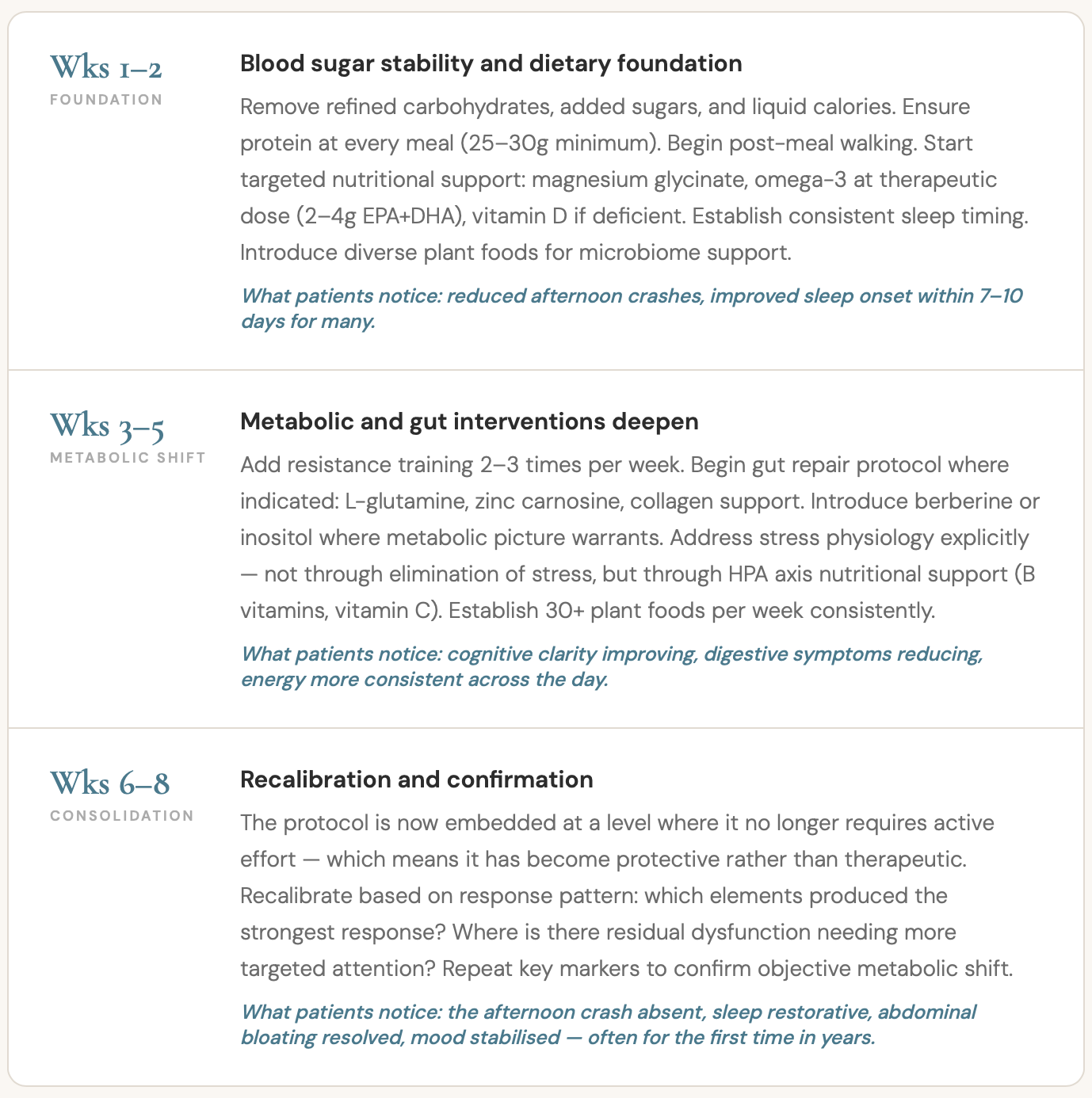
What 8 weeks of Functional Medicine might look like
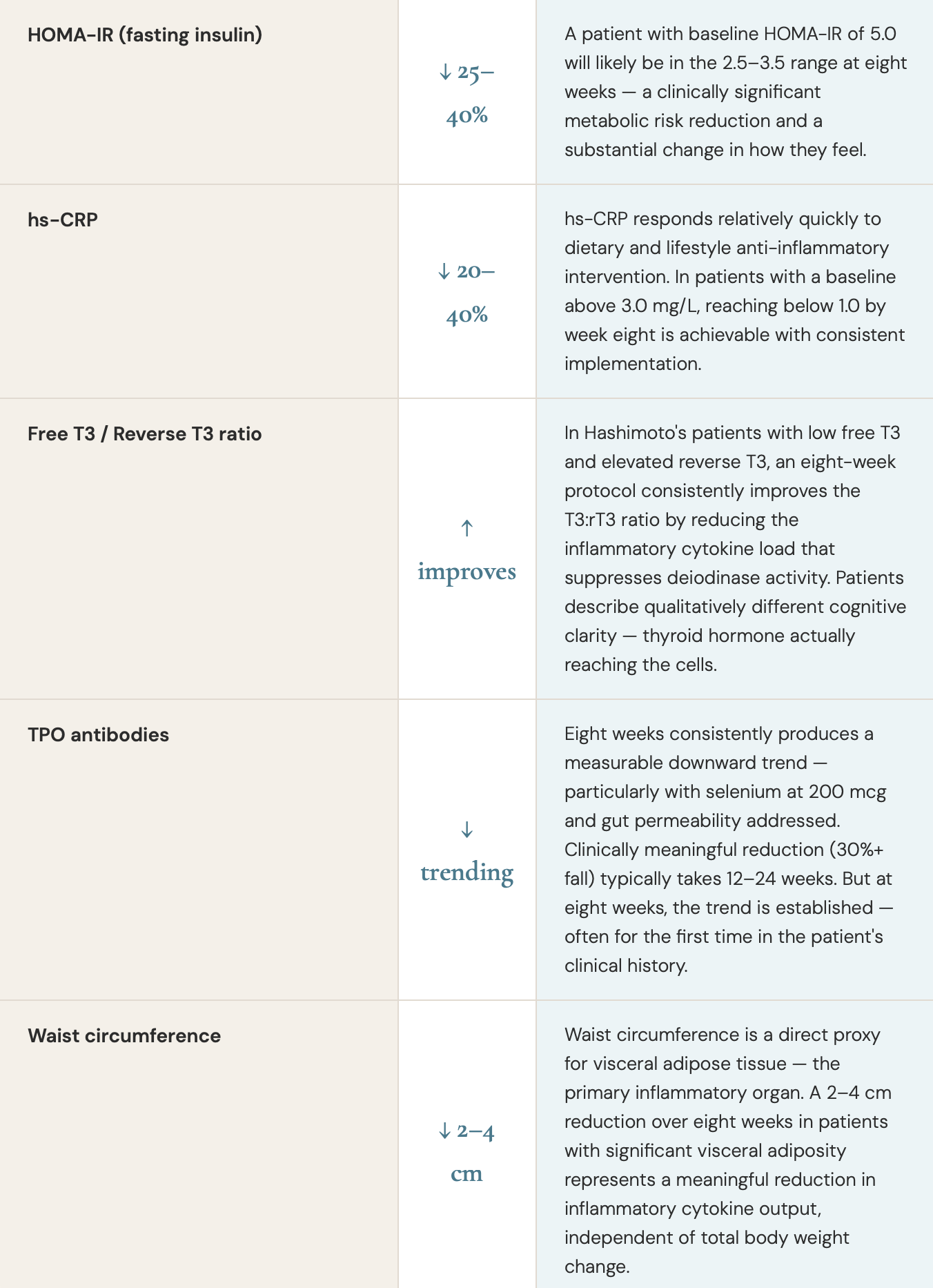
What the Data Might Look Like at Eight Weeks
Here is the objective picture — what the markers actually do in a well-implemented eight-week protocol. This is based on the consistent clinical patterns I see and the published trial data for the individual interventions.
THE QUESTION WORTH SITTING WITH
Of everything covered across April — the metabolic picture, the thyroid and autoimmune connection, the inflammation framework, the eight-week clinical pathway — where do you want to start?
Not all of it at once. Not perfectly. Just: where is the most important first step for your specific picture? That answer is usually already clear if you sit with it honestly. And if it's not, that's what clinical assessment is for.
The framework is not complex when it's sequenced properly. The first week — the Reset — addresses blood sugar stability, dietary anti-inflammatory load, gut support, and the nutritional foundation simultaneously. It is the beginning of the metabolic work, not the whole of it. But it is the right place to start.
April in four threads
WK 1: Insulin resistance — the hidden driver behind fatigue, brain fog and weight that standard testing misses for years.
WK 2: The metabolic roots of autoimmune and thyroid disease — the connection that most specialist care leaves unaddressed.
WK 3: Chronic inflammation as a warning system — the unifying mechanism, its five sources, and the evidence-based framework for addressing it.
WK 4: The map — what the functional medicine assessment involves, why sequence matters, and what changes in the first eight weeks.
The map begins here.
The 7 Day Reset is week one of the metabolic framework — blood sugar stability, dietary anti-inflammatory foundation, gut support, and nutritional basics, sequenced and structured into a single starting week.